Market interventions
If prices are prevented from functioning properly, markets will be less able to reach equilibrium. Therefore price controls (laws that “set” prices at certain levels) will be highly disruptive. There are two types of price control: ones that set prices above their equilibrium/market-clearing rate, and those that set prices below it. When prices are kept below their market-clearing rate, we call it a price “ceiling”. This is because policymakers are trying to prevent prices from rising upwards towards equilibrium. If prices are kept above their market-clearing rate, it’s a “floor”. Policymakers are trying to keep prices artificially high.
Here’s an excellent video on the role of prices in a free market economy:
Now let’s look at the two most famous examples of price controls: Minimum wages and rent control.
Here’s a video on minimum wages:
There are several negative consequences of a minimum wage:
- Reduction in the number of hours worked
- Reduction in other forms of compensation (such as bonus pay)
- Reduction in perks
- Workers are required to cover more of their employment costs than before – for example they have to pay for their own uniform
- Companies substitute capital for labour – capital has become relatively cheaper, so firms automate services that would have been provided by workers, or simply dispense with those services all together (e.g. petrol pump attendants, movie theatre ushers, etc.)
- Training becomes harder to receive – firms are unable to offer training to those workers willing to accept lower wages
- Employed workers become less mobile because they’re less likely to find a job if they move location
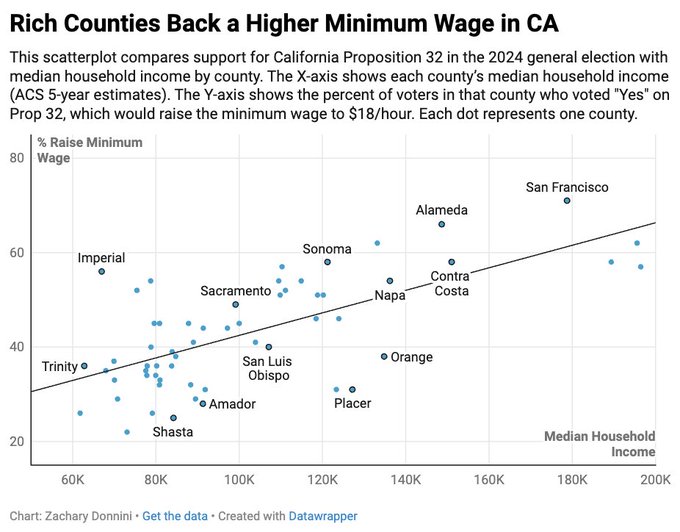
Minimum wages tend to be quite popular, but not so much with people at the lower end of the wage distribution.
While it is obvious that someone would rather have a minimum wage job than a job paying less than that, it seems that people in that situation recognise that low paying jobs are better than losing your job to automation. That might explain why there is a strong correlation between support for minimum wages and income level.
You might think you are helping low earners by supporting minimum wages, but if you care about their interests then listen to them!
Here’s a video on rent control:
Some common consequences of rent control are as follows:
- Black markets – where buyers and sellers trade at prices closer to the market equilibrium
- Reduction in the future supply – due to potential supply being substituted into more profitable ventures
- Fall in quality – landlords will have less pressure to maintain the quality because they are in a stronger bargaining position
- Long waiting lists
- Bribery of those with discretionary ability to allocate resources (in the case of housing this may be city officials; it could just be a university housing officer)
- Inefficient use of existing supply – you might have a small family in a large apartment, and large families in small apartments because neither want to give them up
- Reduction in the mobility of incumbents – if people are enjoying subsidized housing, they’ll be less likely to move
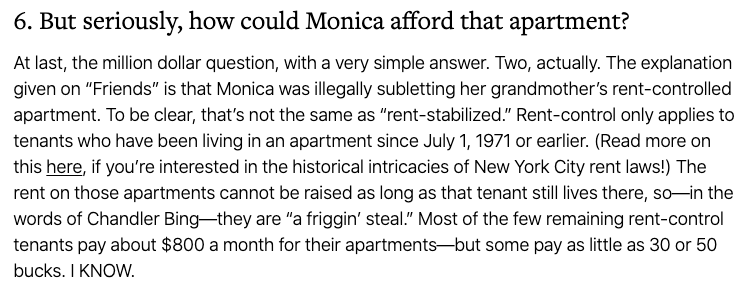
If you ever wondered how, in the TV series Friends, that Monica and Rachel can afford such an amazing apartment on such low salaries, now you know!

In 2020 Berlin adopted rent control and, as economists predicted, it didn’t work.
Perhaps the key lesson of economics is that you cannot escape scarcity.
Next to bombing, rent control seems in many cases to be the most efficient technique so far known for destroying cities
Assar Lindbeck