Global development
Everyone used to be poor. This slideshow reveals how poor people used to be, even in now rich countries:
Because this is an economics course we will predominantly treat development as an economic, measurable phenomenon. This doesn’t mean that we don’t care about broader aspects of human development, such as life expectancy, good health, more leisure, access to education, female empowerment, protections for vulnerable people, political rights, animal welfare or ecological stewardship. In fact, the argument is that economic growth is a necessary prerequisite to achieve those things at scale.
When we talk about economic growth of a few percent a year it can appear trivial. But these have an exponential effect on living standards, and they are a relatively recent phenomenon. Sustained economic growth didn’t really occur before the eighteenth century, and since then has only happened in a few countries. For some parts of the world at present GDP per capita is similar to what it was like in Europe before the Industrial Revolution. It wasn’t until the nineteenth century that some nations began to experience 1% sustained growth per year, and only since the middle of the twentieth century that it has been 2–3%.
Although these numbers seem small, they make a big impact. As Stephanie Flanders has pointed out, the economy grew by about 2.25% per year, on average, from 1970 to 2010. This means that living standards double every 30 years. But if this growth rate slips to 1.25%, it will take 60 years.
If – between the years 1870 and 1990 – the US growth rate had been just 1% less per year than it actually was, then it would have only ended up at the same level of economic development as Mexico. While around 20% of the world’s 7.5 billion people live on less than $1 a day (adjusted for PPP), anyone reading these words will most likely be in the top 1% richest people in the world. Indeed the scale of difference between rich and poor is astounding – the poorest people in a rich country have about three times as much purchasing power as the richest people in a poor country. Not only are you rich compared to the rest of the world, most people in the world today are richer than the very richest of times past.
According to some estimates the richest man of all time was Mansa Musa I. He ruled the Malian empire in the fourteenth century and his personal net worth reached $440bn (in 2018 dollars). But how would his living standards compare to the average person today? For a start he died aged 51.


David Landes has pointed out that “Nathan Mayer Rothschild, the richest man in the world of his time, died in 1836 for want of an antibiotic to cure an infection”.
The richest American of all time was John D. Rockefeller. But the quality of his house, or his car, would seem deprived by today’s standards. In addition, those billionaires lived in an age where income differences were highly visible. These days, if you bumped into a billionaire in the street you would be unlikely to be able to tell.

The increases in global income have been incredible. In Factfulness, Hans Rosling tells us that 100,000 years ago everyone was poor and most children didn’t survive long enough to become parents. 200 years ago, 85% of the world were still in extreme poverty. Today, most people live in middle-income countries, with living standards similar to Western Europe and North America in the 1950s (see p.38).
In the first part of this video, Don Boudreaux explains the recent, rapid growth in prosperity for mankind.
In 2023 India surpassed China as having the world’s biggest population and Thomas Pueyo used this map to link this fact to geographical factors. The whole Twitter thread is fascinating and uses some amazing images.

To some extent the story of the twentieth century is the integration of India and China to the global economy, and the immense wealth and hgher living standards that have occured as a result.
The most spectacular gains in wealth are China and India:
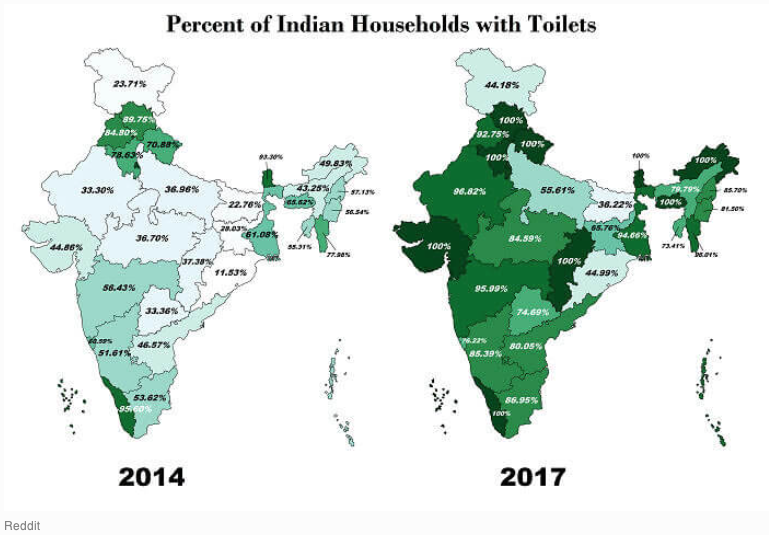
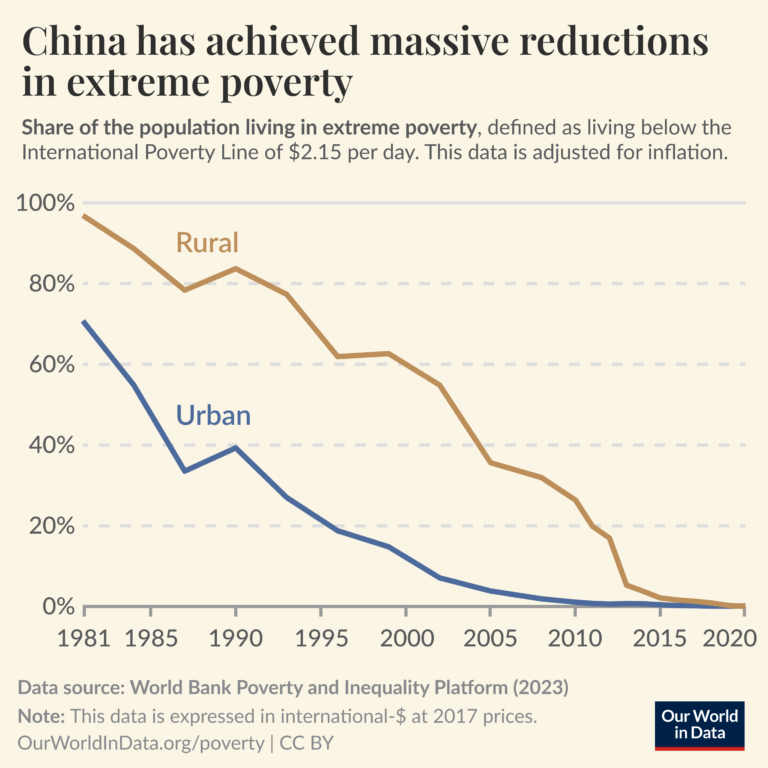
As a result of ~4.8% annual growth, income per person in India almost doubled from 2011-2023. According to this working paper by Ravi and Penumarty:
- The percentage of income spent on food has now fallen below 50%
- Refrigerator ownership in rural areas has increased from 9.4% to 33.2%
- Refrigerator ownership in urban areas increased from 43.8% to 68.1%
As Alex Tabarrok commented, “The 4.8% annual growth matters because it shows up as a broad, visible upgrade in how people live.”
Toilets
One of my favourite examples of how to notice intergenerational progress and increased material prosperity is Vic Wilcox’s thoughts on toilets, from David Lodge’s ‘Nice Work’ (1988) – see here.
Here’s my simple explanation of the causes of economic growth:
The video recognises that a countries starting position can influence their growth opportunities. Endowments are factor inputs or natural resources, and here are some classic examples:
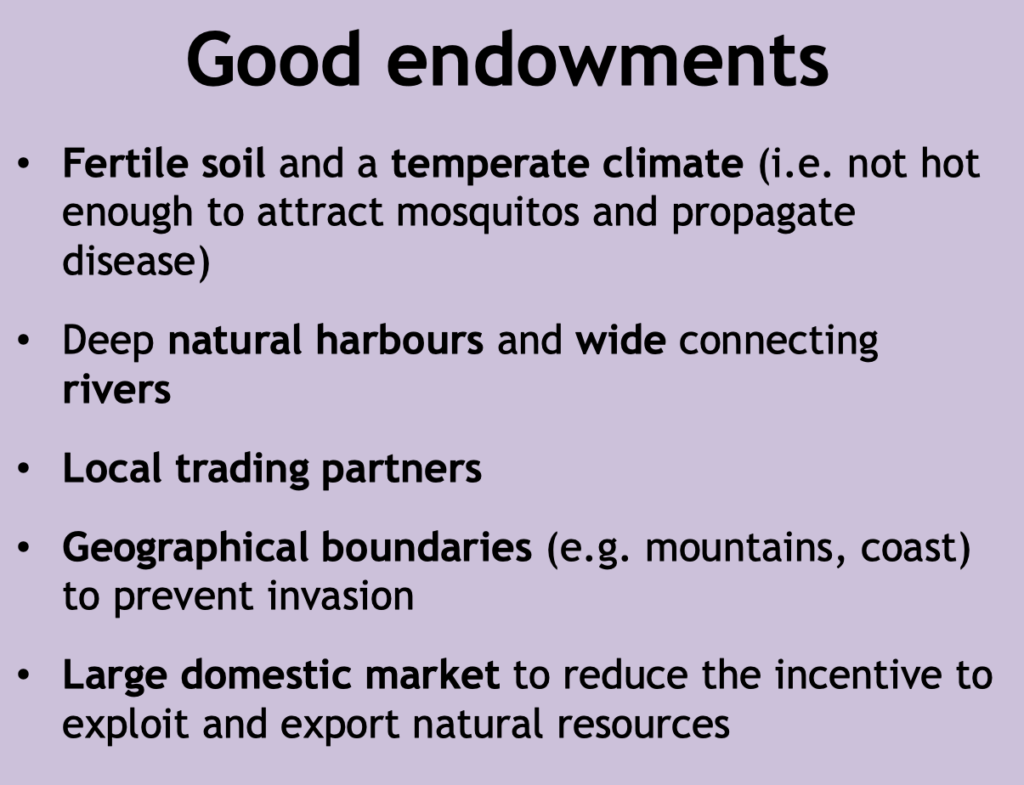
What’s most remarkable is how much of modern, contemporary growth occurs despite weak endowments. This slideshow illustrates before and after photos of famous landmarks.
One reason why economists have done such a poor job making poor countries rich is that it is often a historical accident that results in all three elements – resources, ideas and institutions – being in place. Indeed while it is pretty simple for poor countries to have more “stuff”, knowing what to do with it is harder than it appears. And it is not even worth trying to generate wealth without the right institutions. Attitudes towards economic development have broadly followed these three phases of growth theory.
Economists used to tell the governments of poor countries that growth would come if they increased their savings rate and invested more in physical infrastructure.
Then they urged them to invest in supply side policies like schools and new technologies.
Now they emphasize the right legal system and rule of law.
But identifying the source of economic growth is far easier than being able to generate it. Even though we know why some countries are rich and some countries are poor, it is naive in the extreme to think we are able to export this successfully. Any formal institutions must “stick” with the informal culture that already exists.
Higher incomes are really important, they lead to:
- Reduced population growth – poor communities have lots of children because many will die early, and they need a contribution to family income. As they get richer, the need for more extra children declines and parents focus on quality not quantity… based on current growth projections total global population is due to stabilise at ~11 bn people. As Rosling says, “Once parents see children survive, once the children are no longer needed for child labour, and once the women are educated and have information about and access to contraceptives, across cultures and religion both the men and the women instead start dreaming of having fewer, well-educated children” (p.91)
- Greater concern for the environment
- More resources for humanitarian assistance (e.g. for natural disasters or global pandemics)

One of the most important contributions to the rise in global living standards was the Green Revolution.
A 2021 paper found that “if the Green Revolution had never happened GDP per capita in the developing world would be half of its current level… More realistically, if the Green Revolution had been delayed by ten years incomes in the developing world would be 17% lower today. In terms of cumulative GDP what this means is that the investments which made the Green Revolution possible were responsible for some US $83 trillion in benefits” (summary from Alex Tabarrok).
Unfortunately, we missed out on similar benefits from Golden Rice.
What about degrowth?
Jason Hickel’s book ‘Less is more‘ argues that we need to “shift to a post-capitalist economy that is focused on human well-being and ecological stability rather than on perpetual growth”. Here are my 5 main criticisms of the degrowth movement:
1. It relies on bad economics. In a seminal article published in a highly prestigious journal, Degrowth can work — here’s how science can help, Nature, December 12th 2022 – Hickel et al claim that economic growth is based on production for its own sake and the necessary depletion of natural resources required to fuel it. But this is a fundamental misconception of economics, which is about increasing utility (i.e. people’s subjective judgment of what improves the quality of their life) in the most efficient way possible. As Sam Bowman said, economic growth is about “innovations that use fewer resources & less labour to produce more wellbeing – the [exact] thing the blurb says we should do”.
2. Growth is one of the biggest parts of the solution to our environmental problems. We have successfully decoupled a lot of the negative impact of growth and therefore there’s no fixed trade off between material betterment and environmental protection. In fact, rich countries are growing as their environmental footprint falls (see “The shrinking arguments for degrowth” by John Burn-Murdoch, The Financial Times, June 26th 2026). In addition, the best way to fix our environmental problems is through technology – as Hannah Ritchie has argued, recent breakthroughs in the batteries required for electric vehicles, or low cost solar panels, are a result of economic growth (Ritchie 2024, p.35).
3. Policymakers in rich countries have been prioritising environmental protection over economic growth for over 50 years. Growth rates have become very low in advanced countries (particularly since 2008) and this is because of degrowth arguments. In Degrowth and the Monkey’s paw (by Stian Westlake, Works in Progress, May 15th 2023), Westlake points out that “the UK has been remarkably successful in weaning itself off its growth addiction. I’m surprised that supporters of degrowth don’t celebrate these charts more.”
4. If the argument is for a more extreme response, then this is not compatible with democracy. Martin Wolf has pointed out that, “The transformation… could only be implemented by a dictatorship, and a global dictatorship at that. No such regime is (happily) in prospect. That is at best unrealistic utopianism. At worst, it is yet another in a long succession of “progressive” calls for tyranny” (Wolf 2023, p. 223).
5. Much of what passes as the “degrowth” scientific literature is in fact opinion pieces or aspirations. In Savin, I, and van den Bergh, J., 2024, “Reviewing studies of degrowth: Are claims matched by data, methods and policy analysis?“, Ecological Economics, Volume 226, the authors provide a comprehensive survey of 561 articles from the degrowth literature. They find that: “the large majority (almost 90%) of studies are opinions rather than analysis; few studies use… data… most studies offer ad hoc and subjective policy advice… various studies represent a “reverse causality” confusion, i.e. use the term degrowth not for a deliberate strategy but to denote economic decline (in GDP terms) resulting from exogenous factors or public policies; [and] few studies adopt a system-wide perspective – instead most focus on small, local cases without a clear implication for the economy as a whole.”
A desire to overthrow the economic system on environmental grounds is therefore misguided and counter productive.
I also recommend the following:
– “I read the degrowth paper, so you don’t have to” by Brian Albrecht, January 4th 2024
– The planet’s got 99 problems, but exponential growth is not one, by Tim Harford, Financial Times, February 8th 2024
Economists are often accused of being materialistic. But as Ludwig von Mises said:
He who disdains the fall in infant mortality and the gradual disappearance of famines and plagues may cast the first stone upon the materialism of economists.
Ludwig von mises
If our focus is on Development Economics, and a set of policy prescriptions that can improve the quality of life for the world’s most desperate people, a relatively simple solution is more free migration. Economist Bryan Caplan claims that this is the quickest, simplest and easiest way to impact global living standards.

Open borders might be the closest we have to a “silver bullet” solution to global poverty, but globalization is the core foundation of mass poverty reduction.
I ended up as an activist in a very different place from where I started. I thought that if we just redistributed resources, then we could solve every problem. I now know that’s not true. There’s a funny moment when you realize that as an activist: The off-ramp out of extreme poverty is, ugh, commerce, it’s entrepreneurial capitalism. I spend a lot of time in countries all over Africa, and they’re like, Eh, we wouldn’t mind a little more globalization actually.
Here’s Don Boudreaux on how economics made the world great:
But unfortunately plugging into globalization isn’t always straightforward.
“Attaching to the global trade network is an immense opportunity, but it requires that everything, or nearly everything – infrastructure, scale, public administration, governance, and foreign knowledge of your production capabilities – be working just right. And to fully participate in hyper globalization, a region needs the international airline connections and the hotels required by the firms that orchestrate globally distributed value chains to incorporate them”
Bradford DeLong (2022, p.478)